
Geometry begins long before children learn words like polygon, perimeter, or symmetry.
A child stacks blocks and notices which ones balance. Another turns a puzzle piece until it fits. A student looks at a window and recognizes a rectangle or sees that two halves of a butterfly look alike.
These everyday observations are the beginnings of geometric thinking.
Teaching geometry to kids becomes much easier when we build on those experiences instead of starting with definitions and formulas. Shapes can be touched, moved, built, folded, compared, measured, and found almost everywhere.
That makes geometry one of the best areas of mathematics for hands-on learning.
Teaching Geometry to Kids Starts With More Than Shape Names
Knowing that a figure is a triangle is useful.
Understanding why it is a triangle is more important.
Instead of asking only:
“What shape is this?”
begin asking questions such as:
“How do you know?”
A child might answer:
“It has three sides.”
“It has three corners.”
That small change turns shape recognition into mathematical reasoning.
Children should also encounter shapes in different positions, sizes, and proportions. A triangle does not stop being a triangle when it points downward. A long, narrow rectangle is still a rectangle. A tiny square and a large square share the same defining properties.
If children see only one familiar version of each shape, they can accidentally associate the appearance of the example with the definition of the shape.
Variety helps them understand the properties that actually matter.
Build Shapes Before Expecting Children to Describe Them
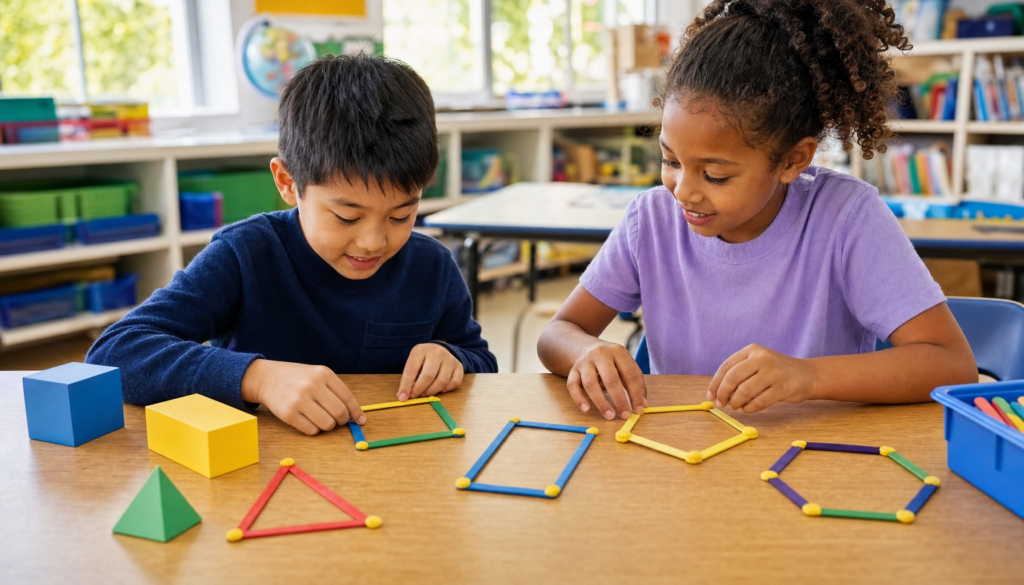
One of the easiest ways to make elementary geometry concrete is to let children construct shapes themselves.
Craft sticks, straws, building pieces, modeling clay, pattern blocks, and similar materials work well.
Ask a learner to make a triangle.
Then ask:
“Can you make a different triangle?”
That second question is powerful.
The child might make one taller, wider, smaller, or turned in another direction. Yet it remains a triangle.
Try the same activity with quadrilaterals.
Can the learner make a square?
A rectangle?
Another four-sided shape that is neither?
Hands-on construction gives children an opportunity to discover that shapes belong to families and that some properties are shared.
That understanding becomes increasingly important as elementary geometry grows more sophisticated.
Help Children See Geometry in the Real World
Geometry is everywhere, which means practice does not always require a worksheet.
Look around a room together.
A tabletop might be a rectangle.
A clock might be a circle.
Floor tiles may contain squares.
A shelf can create right angles.
A ball provides an opportunity to discuss a sphere.
A box can introduce a rectangular prism.
You can turn this into a simple geometry hunt.
Choose one shape or property and ask your learner to find examples around the house, classroom, playground, or neighborhood.
For example:
“Find three rectangles.”
“Can you find something with a right angle?”
“Can you find an object shaped like a cylinder?”
“Where can you see parallel lines?”
This moves geometry from the page into the child’s environment.
It also encourages children to observe rather than simply recall.
Move From 2D Shapes to 3D Shapes Carefully
Two-dimensional and three-dimensional shapes are related, but they are not the same.
That distinction can initially be confusing.
A circle is flat.
A sphere is solid.
A square is two-dimensional.
A cube occupies space.
A rectangle and rectangular prism are similarly related without being interchangeable.
Physical objects make these distinctions much easier to understand.
Give children a ball, box, can, and building cube. Let them hold and turn each object.
Ask what they notice.
Which objects roll?
Which stack easily?
Which have flat faces?
Which have curved surfaces?
What flat shapes can they find on the faces of the solid?
The Traffic Tap source rightly emphasizes physical exploration when moving from flat shapes to solid figures.
Instead of treating 2D and 3D geometry as unrelated lists of vocabulary words, help learners discover the connections between them.
Use Sorting to Develop Geometric Reasoning
Sorting is an easy activity that can become surprisingly sophisticated.
Begin by placing several shapes on a table and asking the learner to sort them.
Do not necessarily tell the child how to sort them.
Ask:
“Which shapes belong together?”
Then ask:
“Why did you put them together?”
A child might sort by color first. That’s fine.
Try again.
“Can you find another way?”
Now the learner might sort by number of sides, size, curved versus straight edges, or another property.
The goal is not merely finding your predetermined answer. It is learning to observe attributes and explain a classification.
That ability becomes valuable far beyond elementary geometry.
Explore Symmetry With Folding and Mirrors
Symmetry is particularly well suited to hands-on learning.
Fold a paper shape in half.
Do the two sides match?
Try another fold.
Does that one work?
Children can investigate which shapes have one line of symmetry, several lines, or none.
A small mirror can make the idea even more visual. Place the mirror along part of a picture or design and observe the reflected image.
Nature provides additional examples.
Butterflies, leaves, flowers, and many other objects can prompt conversations about symmetry, although real objects are not always perfectly symmetrical.
Children can also create symmetrical artwork using blocks, pattern pieces, paper shapes, or drawings.
The important part comes afterward:
“How do you know your design is symmetrical?”
Again, explanation turns an activity into mathematical thinking.
Introduce Perimeter as Distance Around a Shape
Perimeter can seem abstract when children first encounter a formula.
It becomes much clearer when they experience what perimeter represents.
Create a large rectangle on the floor using removable tape.
Ask the child to walk around its boundary.
That trip around the outside is the basic idea behind perimeter.
Now compare two shapes.
Could two rectangles look different but have the same perimeter?
Could two shapes have the same area but different perimeters?
Questions like these gradually move children beyond simply inserting numbers into a formula.
When formal practice begins, the arithmetic has something concrete to represent.
Introduce Area as Covering Space
Area is another concept that benefits enormously from manipulatives.
Draw or create a rectangle and cover its interior with equal-sized square tiles.
How many squares does it take?
Children can physically see that area describes the amount of surface inside the boundary.
Try several rectangles.
Ask learners to predict which has the greater area before counting.
Later, multiplication provides a faster way to determine the answer.
That sequence matters.
Instead of:
formula → answer
the learner experiences:
idea → model → pattern → efficient method
The formula then describes something the child already understands.
Teach Angles Through Turns and Corners
Angles are much easier to recognize when children connect them to familiar objects and movements.
Begin with corners.
Books, tables, doors, windows, picture frames, and tiles provide numerous examples of right angles.
Ask children to hunt for them.
Movement can help too.
Turn right.
Turn left.
Make a quarter turn.
Make a half turn.
Children can experience changes in direction before they are expected to measure angles precisely.
Once they are ready, those intuitive ideas can connect to degrees and angle classifications such as acute, right, obtuse, and straight angles.
Geometry develops in layers. We do not have to introduce every layer at once.
Use Questions That Require More Than Naming
A geometry activity becomes much more valuable when the questions go beyond identification.
Instead of only asking:
“What shape is this?”
try:
“How do you know?”
“What is the same about these two shapes?”
“What is different?”
“Can you build another shape with four sides?”
“Can you make this shape a different way?”
“What would happen if we turned it?”
“Which shape would stack better? Why?”
“Which figure has more sides?”
“Can you find a shape that belongs to both groups?”
These questions encourage observation, comparison, prediction, classification, and explanation.
Those are mathematical habits, not simply geometry facts.
Make Geometry a Construction Activity
Building is one of the most natural ways to explore geometry.
Children can create structures with blocks and then examine the shapes within them.
Older elementary learners can build polygons using sticks or geoboards.
Ask them to create:
a triangle with a particular property,
several different quadrilaterals,
a figure with a line of symmetry,
two rectangles with the same area,
or two figures with the same perimeter.
Now geometry becomes a problem to solve rather than information to memorize.
Construction also reveals misunderstandings quickly.
If a learner cannot build the requested figure, you have something specific to discuss.
Connect Geometry to Art
Geometry and art fit naturally together.
Children can make collages from geometric shapes.
They can create symmetrical pictures.
They can explore repeating patterns.
They can investigate tessellations and discover which shapes fit together without leaving gaps.
They can design buildings using rectangles, triangles, circles, and other forms.
These activities are especially useful for learners who may not immediately connect with traditional pencil-and-paper mathematics.
The mathematical conversation remains important.
Ask the child to describe the shapes used, identify patterns, explain symmetry, or compare different parts of the design.
Art provides the context. Geometry provides the reasoning.
Teaching Geometry to Kids Through Everyday Activities
One of the easiest ways to make geometry meaningful is to connect it to ordinary experiences.
Cooking offers shapes, measurement, fractions, and volume.
Sports fields contain lines, circles, rectangles, angles, and boundaries.
Maps involve position, direction, distance, and scale.
Buildings contain geometric structures everywhere.
Games and puzzles require rotation and spatial reasoning.
Even packing a box involves questions about size, shape, orientation, and space.
The original Traffic Tap article identifies architecture, art, cooking, and sports as particularly accessible real-world connections.
Hands-on exploration also supports the broader goal of helping children reason about shapes, space, measurement, and geometric relationships as their mathematical understanding develops.
Pointing out these connections helps children see mathematics as something they use, not simply something assigned at school.
Watch for Common Geometry Misunderstandings
Sometimes a learner can name familiar shapes but has not yet developed flexible understanding.
You might notice that a child:
recognizes a triangle only when it points upward,
thinks every rectangle must be long and horizontal,
does not recognize a square as belonging to the broader family of rectangles,
confuses a circle with a sphere,
uses size to classify shapes instead of properties,
or memorizes formulas without understanding what they measure.
These are useful clues.
They tell you what kind of experience the learner needs next.
If orientation is causing trouble, rotate shapes.
If 2D and 3D figures are being confused, compare physical objects.
If area and perimeter are mixed up, return to covering the inside versus measuring around the outside.
More practice is not always the answer.
Sometimes different practice is.
Let Worksheets Reinforce Understanding
Worksheets absolutely have a place in geometry.
But they work best after a learner has some understanding of what the symbols and diagrams represent.
Hands-on exploration can introduce a concept.
Conversation can develop the language.
Visual models can strengthen the connection.
Then written practice helps children apply and retain what they have learned.
This is particularly important as geometry becomes more advanced.
By upper elementary grades, learners may be working with classifications of polygons, angle relationships, coordinates, transformations, area, perimeter, and volume. Encouraging Math’s own advanced geometry materials progress into precisely these areas.
The goal is not to avoid written practice.
It is to make the practice meaningful.
Geometry Can Grow With the Learner
One of the strengths of geometry is how naturally it develops across grade levels.
A young learner may begin by recognizing a triangle.
Later, that child can describe its sides and vertices.
Then classify different types of triangles.
Then measure its angles.
Then calculate its area.
Eventually, the learner may use triangles in coordinate geometry, transformations, proofs, or more advanced applications.
The subject grows, but the underlying habit remains remarkably consistent:
Look carefully at a figure and reason about what you see.
That is why early hands-on geometry is valuable.
The colorful blocks and craft sticks are not separate from “real math.”
They are an accessible starting point for the spatial reasoning children will continue developing for years.
Keep Geometry Active, Visual, and Curious
When teaching geometry to kids, you do not need to introduce every vocabulary word or formula at once.
Start with what children can see and touch.
Build shapes.
Turn them.
Sort them.
Fold them.
Cover them.
Measure around them.
Find them in the real world.
Then give children opportunities to explain what they notice.
As understanding grows, written practice can help make those ideas more precise and more fluent.
Geometry becomes much less mysterious when children realize that shapes, angles, patterns, space, and measurement have been around them all along.
The goal is to help them begin seeing the mathematics that was already there.
Continue Exploring Math Help & Guidance
Explore more Math Help & Guidance from Encouraging Math for practical strategies, teaching ideas, and clear explanations designed to make math easier to understand and practice.